PolarCool News & Tips
Sizing an evaporative cooler fan correctly is essential for achieving effective cooling and efficient operation. If the fan is undersized, it won’t deliver enough airflow to cool the area properly. If it’s oversized, you may spend more on equipment and energy than necessary.
Evaporative cooling performance is measured in CFM (cubic feet per minute). CFM indicates the amount of cool, fresh air that moves through a space each minute. The higher the CFM rating, the greater the airflow and cooling potential.
This guide explains how to calculate the right CFM for your space and adjust for real-world conditions.
Step 1: Calculate the Required CFM
The easiest way to estimate evaporative cooler capacity is by calculating the volume of the space you want to cool.
Primary Formula
(W × L × H) ÷ 2 = Required CFM
Where:
- W = Width of the space (feet)
- L = Length of the space (feet)
- H = Ceiling height (feet)
This formula estimates the airflow required to cycle fresh, cooled air through the space properly.
Example Calculation
Let’s say you want to cool a building that measures:
Width: 30 ft
Length: 60 ft
Ceiling Height: 10 ft
First calculate the volume:
30 × 60 × 10 = 18,000 cubic feet
Next apply the evaporative cooling formula:
18,000 ÷ 2 = 9,000 CFM required
Now compare that number to the airflow rating of your evaporative cooling fan.
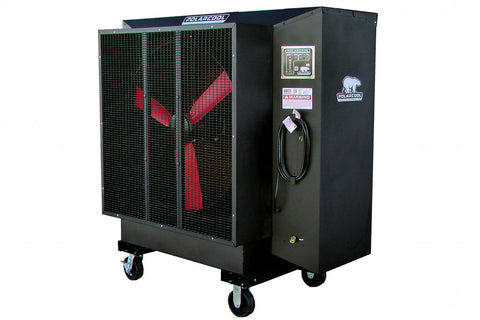
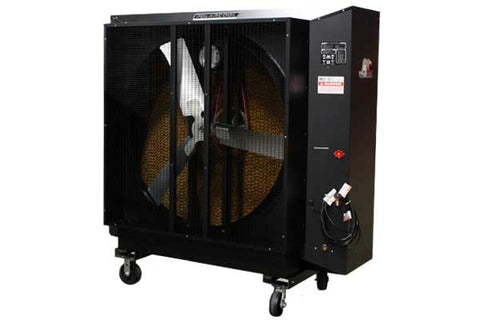
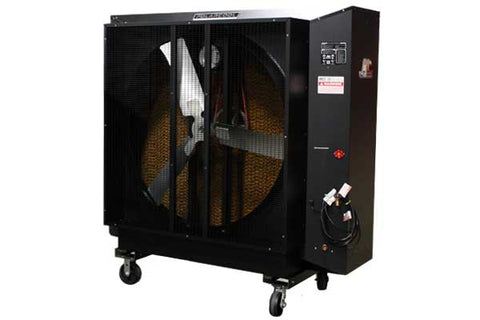
If you were using the PolarCool 36” Pro Model Fan, which is rated at 10,000 CFM, a single unit would be sufficient to cool that area effectively.
To determine the number of fans needed:
Required CFM ÷ Fan CFM Rating = Number of Fans
In this example:
9,000 ÷ 10,000 = 1 fan required
Step 2: Adjust for Environmental Factors
The basic formula works well for standard buildings, but real-world conditions can change your cooling requirements. Factors such as ceiling height, insulation, and whether the system is used indoors or outdoors can all impact performance.
Below are recommended adjustments.
High Ceilings
If your ceilings are higher than 12 feet, increase the CFM requirement by 25% to maintain proper airflow and cooling distribution.
Higher ceilings increase the total air volume that must be circulated.
Poor Insulation
Spaces that are poorly insulated or exposed to direct heat require more airflow to maintain cooling performance.
Add 30% more CFM capacity if the building lacks proper insulation.
Outdoor Applications
Outdoor spaces require significantly more airflow because cooled air is not contained.
For patios, outdoor workspaces, and open-air environments, increase the required CFM by 50% compared to indoor calculations.
Spot or Zone Cooling
If the goal is to cool a specific work area rather than an entire building, airflow should be concentrated.
Increase your calculated CFM by 25% when planning spot cooling to ensure adequate airflow reaches the target area.
Step 3: Choose the Right Fan Size
Once your adjusted CFM requirement is calculated, select a fan—or combination of fans—that meets or slightly exceeds that number.
In many cases, multiple smaller units provide better airflow distribution than a single large fan. This helps eliminate hot spots and improves comfort throughout the space.
When planning a system, also consider:
- Airflow direction
- Placement of fans
- Ventilation openings for air exhaust
- Obstructions such as equipment or shelving
- Proper airflow design is just as important as selecting the right fan size.
Final Thoughts
Correctly sizing your evaporative cooler ensures that your cooling system delivers the airflow needed to maintain comfortable temperatures while operating efficiently.
By calculating your CFM requirement, adjusting for environmental factors, and selecting the appropriate fan capacity, you can design a cooling solution that performs reliably in a wide range of applications.
Whether cooling a workshop, warehouse, patio, or agricultural facility, choosing the right evaporative cooler size is the first step toward maximizing cooling performance.
Powder Coated